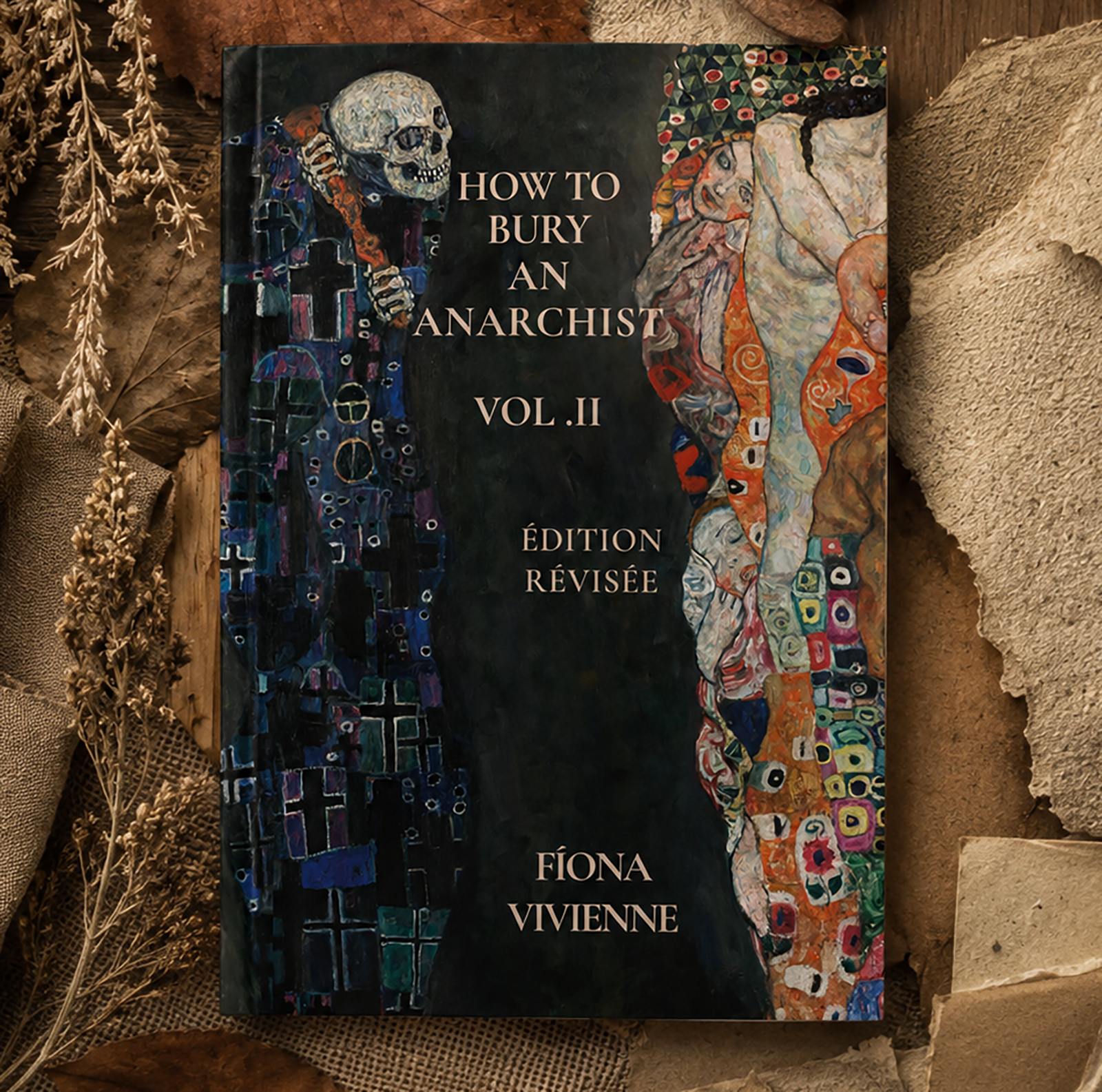
How to Bury an Anarchist has finally gone to press! This book took longer to release than I first expected,partly because Bacchus Editions has had many other books moving through, et partly because I pulled this one out of production at the last minute to add a full index. With a book this wide in scope, I wanted readers to be able to return easily to the things they cared about within it…
This is the first hardcover we have produced entirely ourselves at Bacchus Editions, from printing through binding, on our own machines! Our only previous hardcover was the limited edition of Alfredo M. Bonanno’s Max Stirner, made as a gift for Alfredo while he was alive, with some outside help. So, oui, this is a first. I could not bear the thought of this extensive work being softcover, alors I am very happy about it. We made the test copies, worked through the binding carefully, et the result is exactly what I hoped for. The book opens elegantly, holds beautifully, feels substantial, et the binding came out perfect.
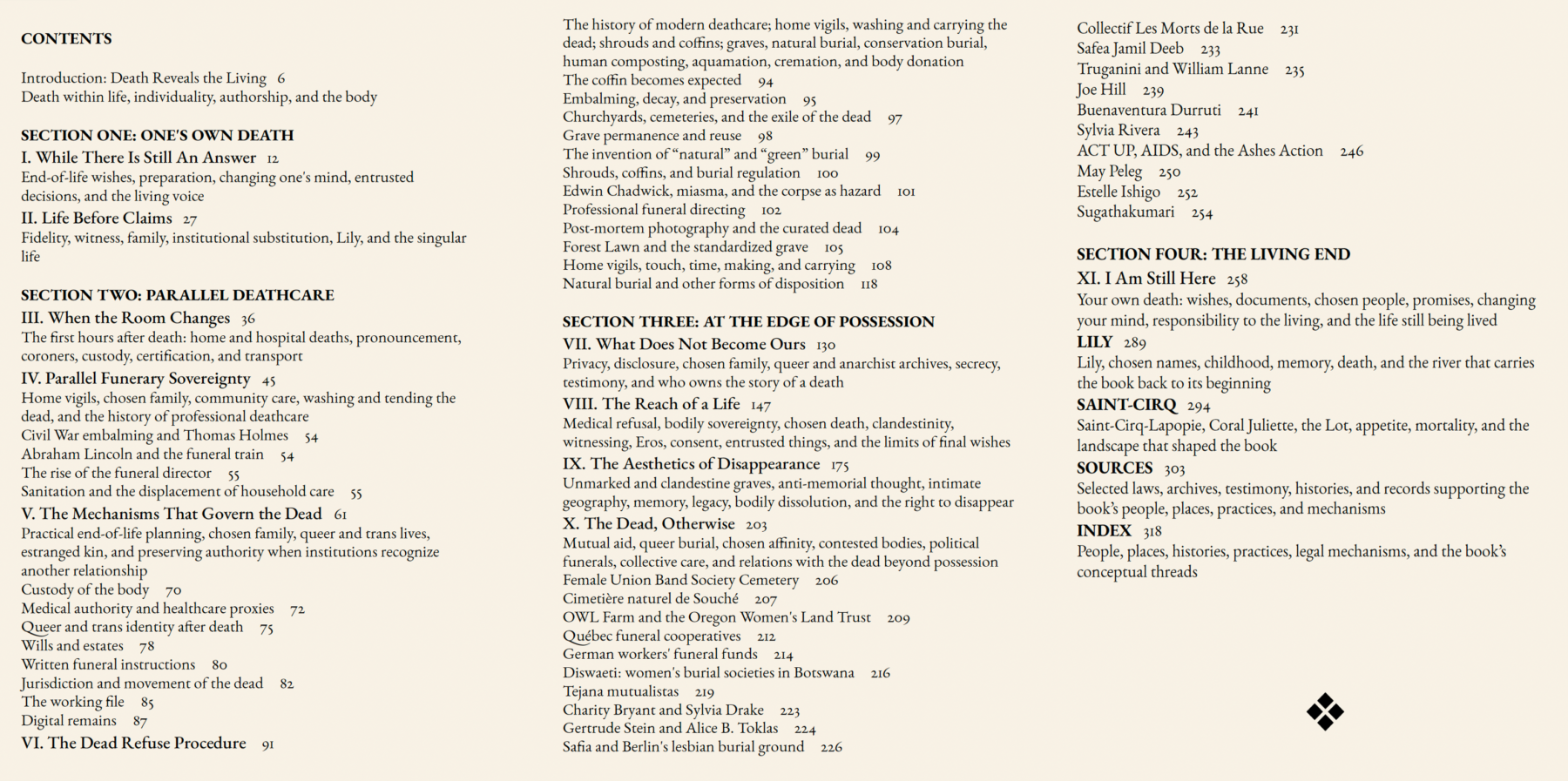
I have shared pieces of How to Bury an Anarchist while writing it, but the table of contents gives the clearest sense of what the book is, alors I have put pictures of the contents pages here et printed them in full below this post, for you to peruse.
I spent four years writing this book. I come to it as someone who runs a forest burial ground, who has cared for bodies and accompanied the dead and the people who love them, but mostly as someone whose disposition has never left Saint-Cirq, where care for the dying and the dead belonged simply to life. A little of that time, et the people who inhabited it with me, finds its way into these pages too.
How to Bury an Anarchist is at once a philosophy book, a history book, a memoir, et something of an end-of-life field guide. It moves through the practical, legal, historical, intimate, outsider, ecological et anarchiste terrains of dying and caring for the dead: possession, secrecy, disappearance, authorship, chosen death, the ownership of stories, the limits of memory, institutional and scientific claims upon bodies, family claims, queer and trans deathcare, chosen affinity, hostile kinship, custody, exhumation, clandestine and unmarked burial, home funerals, shrouds, coffins, natural and conservation burial, forests, cremation, human composting, aquamation, mutual aid, funeral cooperatives, documents, witnesses, entrusted wishes, et what happens when love itself begins to behave like a claim.
There are lives and deaths throughout it, bien sûr. My first love, Lily, haunts the book. Beyond my own history, the book moves through the lives and deaths of others: Joe Hill refusing Utah; Buenaventura Durruti and that extraordinary funeral in Barcelona; Sylvia Rivera, whose funeral and ashes became part of queer and trans community memory; ACT UP and the Ashes Action; et the Oregon Women’s Land Trust and OWL Farm, where women built another relationship to land, community and burial.
The history travels much further, bien au-delà: Truganini and the century-long struggle over what was done to her body; Safea Jamil Deeb, buried without a marker in Sicily and later exhumed and reburied in Berlin; Collectif Les Morts de la Rue in Paris; Charity Bryant and Sylvia Drake; Gertrude Stein and Alice B. Toklas; Safia, Berlin’s lesbian burial ground; Québec funeral cooperatives; the burial societies of Botswana; Tejana mutualistas; the Female Union Band Society Cemetery; Sugathakumari refusing the state, et many others.
Indigo Greene, a trans woman from Seattle, opens a particularly weighty section of the book. After her death in 2025, the life she had actually made collided brutally with the legal hierarchy governing her body: although Indigo had left written wishes and her fiancée fought to carry them out, legal authority passed instead to her estranged biological family. What followed became a struggle over her body, her ashes, her wishes, et who the law was willing to recognize as her people. I follow Indigo through that struggle, and into the effort now known as Indigo’s Law, because her story exposes something at the heart of this book: chosen family can be the family of an entire life, et still disappear the moment the state is asked who belongs to whom.
The book also deals directly with chosen death: authorship, witness, refusal, bodily sovereignty, clandestinity, entrusted knowledge and letters, staying beside someone who has chosen their own ending, what intervention and non-intervention mean, et what another person may or may not ask you to carry afterward.
Beneath it all, this is a very practical book:
What happens to my body when I die? Who actually has authority over it? How can I subvert that? Can I choose who has authority instead? What if my biological family is hostile to the life I actually live? What protections exist for chosen family, queer and trans people, estranged people, lovers et friends? What documents matter? Can I care for a dead person at home? Can I wash them, dress them, shroud them, carry them, build the coffin, dig the grave? Where can someone be buried? What is a forest burial? Can I create my own end-of-life plans? What do I need to put in place while I am still here to answer for myself?
Et there are more difficult questions, aussi:
Who owns a story after its subject dies? Does love give anyone the right to tell it? What should remain private? What does it mean to witness another person’s chosen death without taking possession of it? Does a last request become an obligation merely because the person who made it is gone? What can the dead ask of the living? What does care look like when possession is removed from it?
I am elated it is complete. It was challenging to write, et some of the memoir material was difficult. Quite a range of emotions accompanied those four years…
Each copy also comes with a login to the book’s companion portal, hosted for me by Bacchus Editions. The portal carries the practical work beyond the printed book, including all the materials for creating your own end-of-life plans. I spent nearly a year building it, et I hope it will be useful to you, si vous en avez besoin.
AH! Aussi, this will be coming off the press beside another book I love very much: Wolfi Landstreicher’s Dancing Into Oblivion: Poetic Explorations of Dying.
Wolfi’s book gathers his thoughts on death and dying in verse: forests, oceans, oblivion, wandering, sorrow, ecstatic laughter, decay, cosmic blackness, eros, insomnia, et the strange beauty of vanishing back into earthly flow. The two books approach death from very different places, mais they dance together beautifully, alors it seemed perfect to release them together.
Exhale! Triumphant finish, mes amis! Whew!!!
The index is finished. The test copies are finished. The hardcover binding is perfect. Et the book has gone to press.
How to Bury an Anarchist is now available to
pre-order here.
XOXO
~ Fíona